SHED BUILD PLANS · 2026-10-12-reading-v5 · Independent planning reference
Open-front Bike Storage Case Study
An open front removes the door-swing task, but the person and bicycle still need room outside. Use this documented project to examine retrieval and exposure together.
Is the outside approach part of your storage plan?
Look at the enclosure, the illustrated bicycles and the open front separately. An overall width cannot supply the missing internal depth or establish capacity.
Visible, direct access to children’s bikes and scooters.
The same open face provides easy retrieval and leaves the contents exposed.
Reference material, not construction plans. Drawings disclose selected assumptions; they do not establish structural design, permit approval or species capacity.
Overall width is not usable floor depth
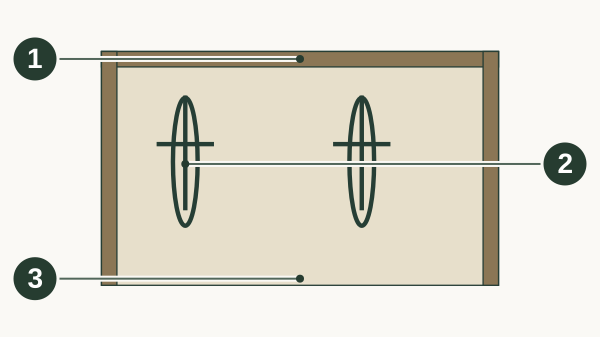
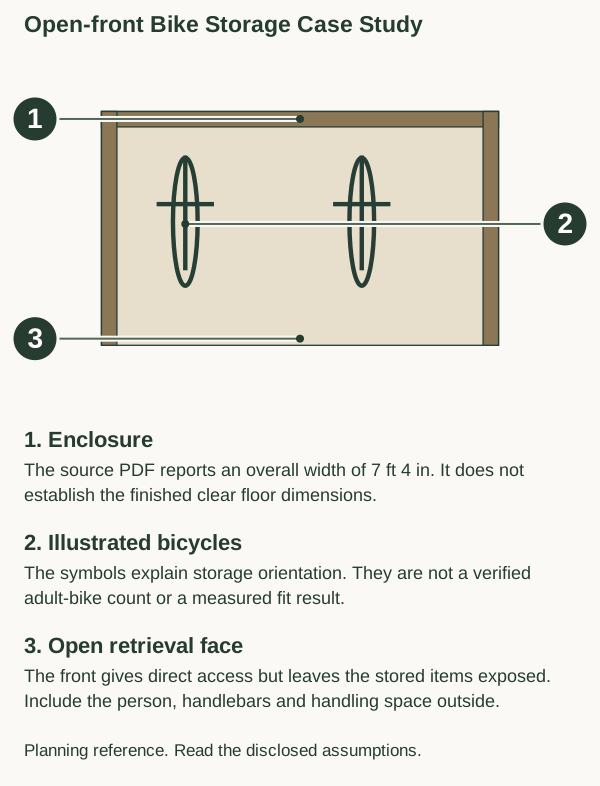
The source width label cannot supply the missing usable depth.
- 1. Enclosure
- The source PDF reports an overall width of 7 ft 4 in. It does not establish the finished clear floor dimensions.
- 2. Illustrated bicycles
- The symbols explain storage orientation. They are not a verified adult-bike count or a measured fit result.
- 3. Open retrieval face
- The front gives direct access but leaves the stored items exposed. Include the person, handlebars and handling space outside.
Check the original plan dimensions against your own equipment rather than estimating capacity from the illustration.
Study notes & exact inputs
Original diagram. Unscaled original schematic; no verified clear dimensions.
The original PDF contains materials, cuts and steps. Its first-page width is not a usable-interior measurement. Its front-opening label must not be relabeled as footprint depth.
The shapes represent a retrieval arrangement, not a count of bikes that will fit your equipment.
Follow the source labels. Overall width, front opening and floor depth describe different measurements. Do not substitute one for another.
Use the original build resource. Its materials, cuts and steps belong to the original provider. Our figures explain access only.
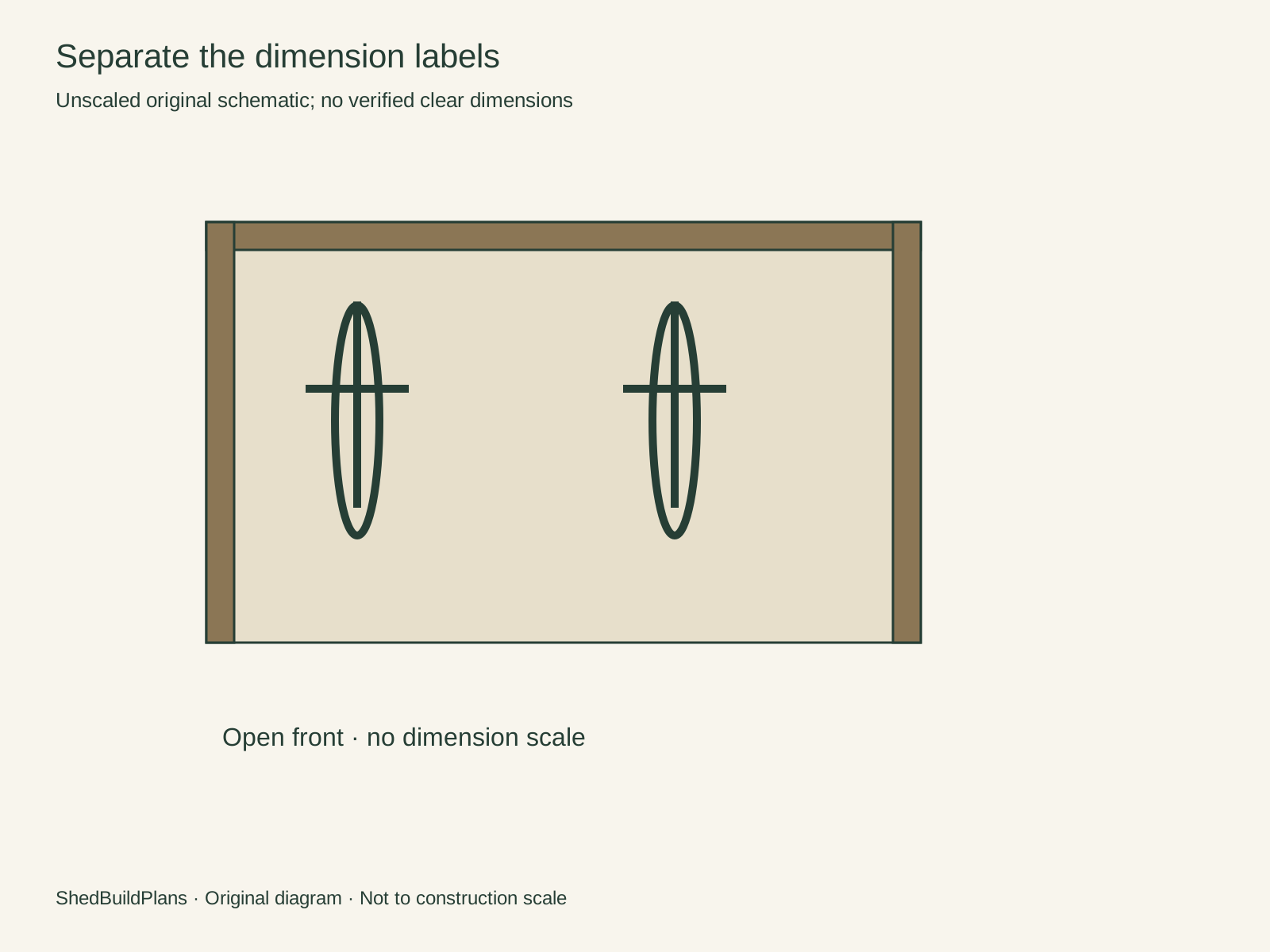
Keep a clear approach to the selected bike
Use the open front as an approach
Select the item
Approach the chosen bike or scooter without moving a front door.
Roll or lift out
Check handlebars and wheels through the threshold and past adjacent equipment.
Handle it outside
Continue to a place where you can stand and steer without blocking the next item.
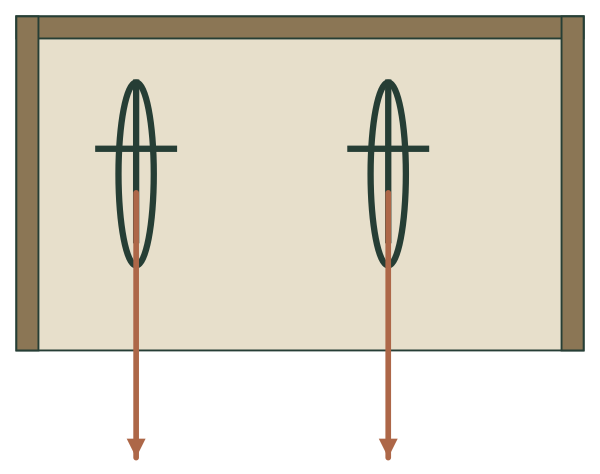
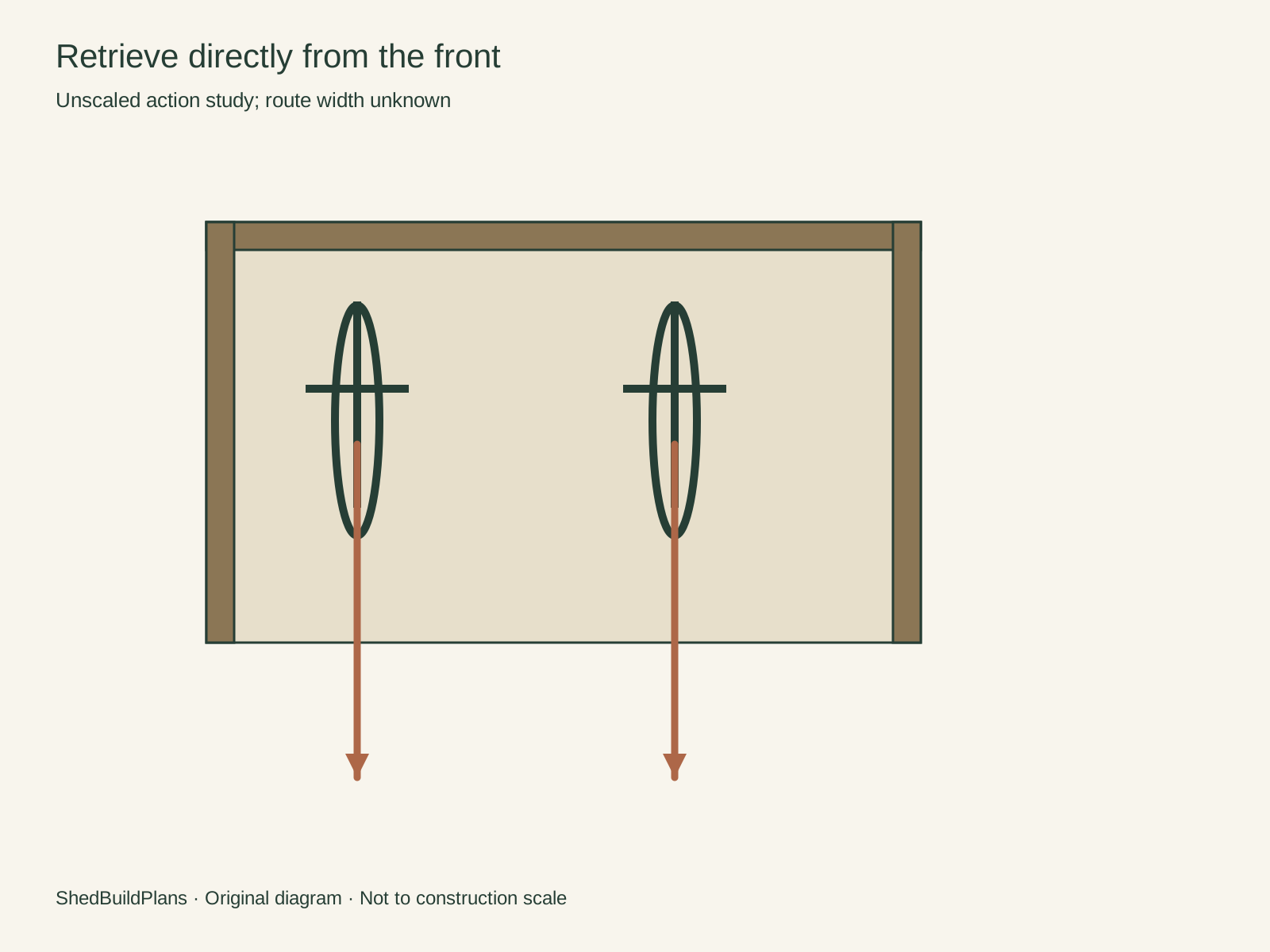
The open face removes a door swing from the retrieval task.
- No front-door swing
- The approach starts at the open face, so there is no front door to move aside.
- Still allow handling space
- Handlebars, wheelbase, the threshold and your lifting or rolling action remain part of retrieval.
Roll your largest intended bike or scooter through a mock opening and into the outside approach.
Study notes & exact inputs
Original diagram. Unscaled action study; route width unknown.
Keep an approach in front of the chosen bike or scooter. Verify your handlebars, wheelbase and ability to lift or roll over the threshold.
The source’s children’s-equipment use does not establish independent retrieval of larger bikes.
The retrieval face also stays open to the surroundings
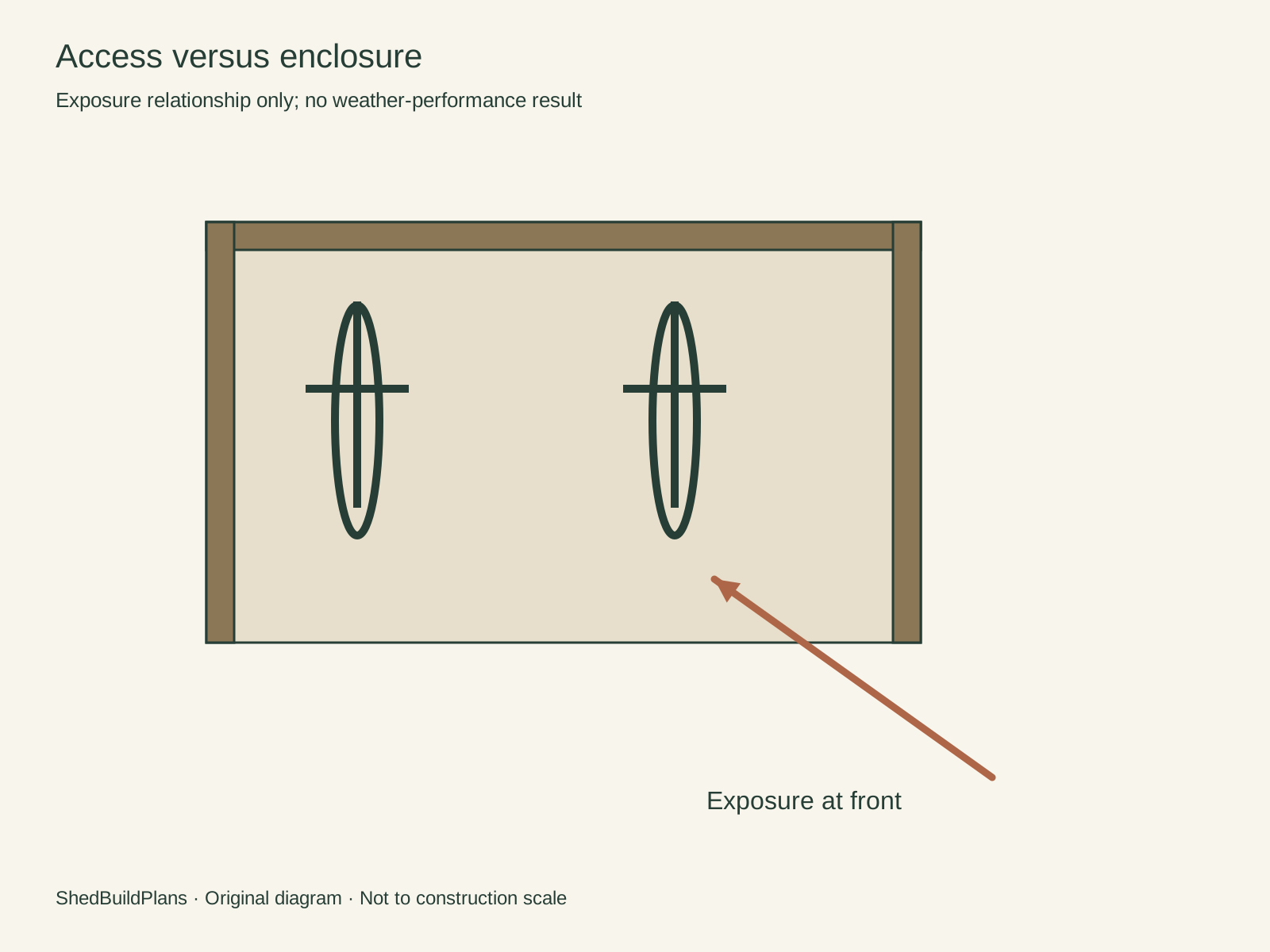
The face used for access is also the face left open.
- Read the trade-off
- Easy retrieval and an exposed front come together in this arrangement.
- Compare an enclosed case
- The enclosed bike reference offers a different access pattern; it does not establish matching capacity or dimensions.
Review the actual location's exposure and security needs before choosing an open-front arrangement.
Study notes & exact inputs
Original diagram. Exposure relationship only; no weather-performance result.
Choose an open front only after considering weather exposure and security. A roof outline alone does not prove that stored items remain dry.
Compare with the enclosed 7×4 bike case; keep its source-reported size and unknown capacity separate from this project.
Study notes & exact inputs
Overall width is not usable floor depth
Original diagram. Unscaled original schematic; no verified clear dimensions.
The original PDF contains materials, cuts and steps. Its first-page width is not a usable-interior measurement. Its front-opening label must not be relabeled as footprint depth.
The shapes represent a retrieval arrangement, not a count of bikes that will fit your equipment.
Follow the source labels. Overall width, front opening and floor depth describe different measurements. Do not substitute one for another.
Use the original build resource. Its materials, cuts and steps belong to the original provider. Our figures explain access only.
Keep a clear approach to the selected bike
Original diagram. Unscaled action study; route width unknown.
Keep an approach in front of the chosen bike or scooter. Verify your handlebars, wheelbase and ability to lift or roll over the threshold.
The source’s children’s-equipment use does not establish independent retrieval of larger bikes.
The retrieval face also stays open to the surroundings
Original diagram. Exposure relationship only; no weather-performance result.
Choose an open front only after considering weather exposure and security. A roof outline alone does not prove that stored items remain dry.
Compare with the enclosed 7×4 bike case; keep its source-reported size and unknown capacity separate from this project.
Decide whether an open retrieval face suits this location
Use the drawings as a starting point. Record the result of each check before carrying this arrangement into your own plan.
1. Keep source dimensions distinct
The source reports overall width and a front opening; neither supplies the missing usable depth. See the drawing
- Measure or try
- Find or measure the clear floor, opening and the actual parked bicycle dimensions.
- Change the arrangement if…
- If any fit-critical measurement is missing, leave the bike count open rather than scaling it from the picture.
2. Include the outside handling area
There is no front door swing. The bicycle, person and threshold still participate in retrieval. See the drawing
- Measure or try
- Mock up the measured opening and take the largest intended item through it with the neighboring item parked.
- Change the arrangement if…
- If handlebars, the person or the outside boundary interrupt the trip, change spacing or orientation and repeat it.
3. Accept the exposed face deliberately
The same face serves retrieval and remains open to the site. See the drawing
- Measure or try
- Record what would be exposed and how you intend to secure the actual stored items at that location.
- Change the arrangement if…
- If the intended use requires an enclosed front, compare an enclosed reference and account for its door operation.
Do not infer capacity from the source photograph
- Width and depth
- Verify clear floor dimensions; the source opening label is not a depth measurement.
- Largest equipment
- Test the actual bike or scooter, not an assumed child-bike size.
- Exposure and security
- Assess the real location and the degree of enclosure you need.
Preparation notes
Do not infer capacity from the source photograph
- Width and depth
- Verify clear floor dimensions; the source opening label is not a depth measurement.
- Largest equipment
- Test the actual bike or scooter, not an assumed child-bike size.
- Exposure and security
- Assess the real location and the degree of enclosure you need.
Where this reference fits
- Visible, direct access to children’s bikes and scooters.
- Comparing an open front with an enclosed bike shed.
Trade-offs
- Open access also leaves stored objects exposed at the front.
- Adult bike capacity, locking and wind-driven rain performance are not established.
Still to assess
- Measure your equipment, roof projection, usable depth and clear approach.
- Confirm anchorage, weather exposure, locking needs and local requirements.
- Check source revisions before using the author’s material and cut lists.
Declared facts & assumptions
The source PDF lists 7 ft width, 4 ft front opening and 5 ft rear height. Opening axis and usable depth are not verified; do not infer a 7×4 ft footprint.
- Source listed overall width: 84 in
- source reported · Source PDF p1; not clear interior. [3x3]
- Usable clear opening: not supplied
- source reported · The source label does not establish both clear axes. [3x3]
- Adult bicycle capacity: not supplied
- source reported · Not established by the author’s child-bike example. [3x3]
Sources & current resource status
DIY Bike Shed — original build account
3x3 Custom · US reference; confirm local conditions · Checked 2026-09-14
Documents the open-front build and links its nine-page plans. The author discloses sponsorship and affiliate links. Our diagram is an independent schematic.
Original assumptions and diagram manifest
ShedBuildPlans · US reference; confirm local conditions · Checked 2026-09-14
Defines this study’s authored geometry and questions; not built-project evidence.
DIY Bike Shed — original build account
3x3 Custom · free · available · Checked 2026-09-14
Public original source. Opens with its provider; no third-party material is hosted here.
Open provider resourceDIY Storage Shed — original nine-page PDF
3x3 Custom · free · available · Checked 2026-09-14
Opens at the author’s provider. No signup was required when checked. Definitions of overall and opening dimensions need confirmation.
Open provider resourceOriginal PDFs remain available on the project page as historical study editions. The current guide and chapter figures are included here.
Project page and current resources