| State | Measure or record | Compare with |
|---|---|---|
| Parked | Body, wheels, handles and closed height | Usable floor and neighboring bin |
| Lid open | Full lid travel and rear projection | Lowest roof or beam obstruction |
| Tilted | Handle position, cart envelope and operator | Front opening and standing area |
| Moving out | Whole route including turns and gates | Other parked bin and outside obstacles |
Use the actual cart, not just its gallon label
Record the manufacturer and model of each bin, then measure the widest body, wheels and handles together. Note the closed height and the front-to-back projection in its parked orientation. Waste and recycling bins may differ even when you intend to store them side by side.
Toter’s residential product page publishes dimensions by specific cart model and describes tilting as part of two-wheel-cart use. Use the equivalent documentation for your own cart and verify it on the object. A capacity label alone does not supply the complete shape or motion needed to assess an enclosure.
Measure four different states
First mark the parked footprint. Next operate the lid through its full intended travel, recording the high point and any rearward projection. Then examine the tilted position used to move the cart, including handles and wheels. Finally trace the route out with room for the person moving it.
Do not combine these into one unsupported clearance number. A fixed roof needs a lid-motion check against the lowest actual beam or obstruction. A threshold and a turn require different information from a straight floor rectangle. Record missing dimensions as unknown until the supplier or an actual measurement resolves them.
Take either bin out without rearranging the other
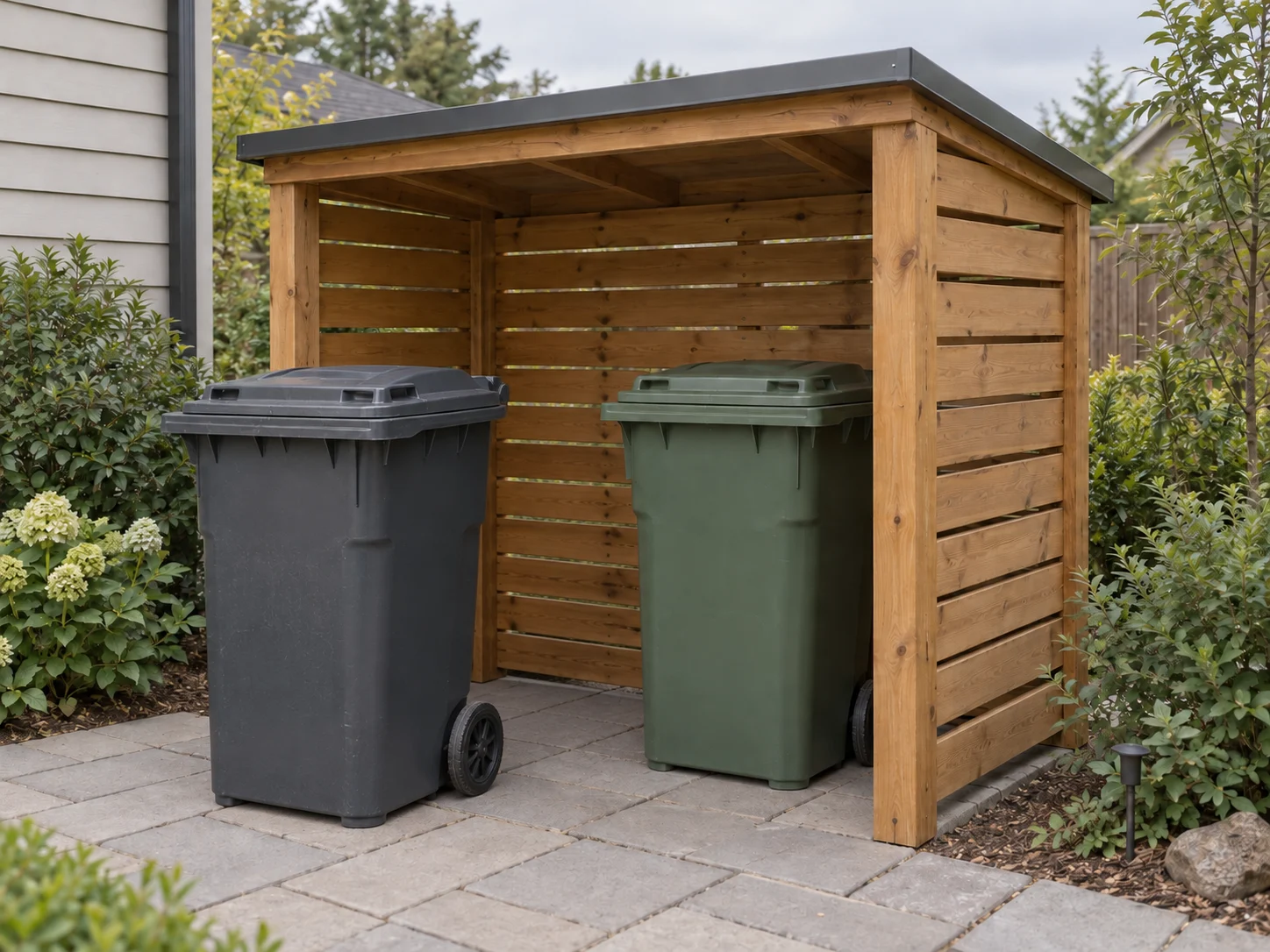
Our 6×4 open-front study uses a selected 68×44 in usable floor and two illustrative 24×28 in bins. Each straight retrieval strip is 28 in wide, with a selected 2 in allowance on either side of the footprint. These are authored examples; no commercial model, gallon capacity or universal handling allowance is claimed.
The baseline has a 60 in clear front and no center post. Add a 6 in post in the illustrated location and the front divides into two 27 in openings. Each is 1 in narrower than the selected retrieval strip, although the two bins still fit in their parked locations. The post is a geometric comparison, not a framing instruction.
Follow the route beyond the shelter
Continue the check from the enclosure to the place where the bin is presented for collection. Record changes in level, gate openings, turns and the space needed to hold or move each cart. The study shows only a 32 in exterior segment; that illustration does not establish sufficient maneuvering room or validate the rest of the route.
Check collection and placement instructions with your own service provider. Storage and collection positions can be different. If you plan front doors for screening, include their open leaves, hardware and the location where you stand while unlocking and moving the cart. An attractive closed front adds a task as well as changing the appearance.
Choose enclosure details after the movement check
Decide what you want the enclosure to do: screen the view, limit weather exposure or secure access. The open-front concept illustrates timber slats and a fixed roof, but it does not establish pest exclusion, odor control or roof support. Ask the supplier to describe the actual assembly and the performance it provides.
Leave a way to inspect and clean the floor and the bins using their care instructions. Record where cleaning water is managed under applicable local requirements rather than assuming gaps in the floor solve disposal. Keep the measured-cart sheet, lid-height question and independent roll-out sketch with any quote so a finish choice does not silently replace the access requirements.
Keep these questions with your project.
0 of 6 reviewed · selections stay on this page
Continue from here
Sources & scope
These references support the questions above. For product-specific work, use the selected manufacturer’s current instructions.
Checked October 8, 2026. Model-specific dimensions and two-wheel-cart handling context; no listed cart is used as this study’s illustrative bin.
Original floor, cart and route assumptions. Available lid-open clearance remains unknown.
Editorial policy and corrections · Our source and calculation method